Maternity schemes in India in 2026 cover millions of pregnant women through a robust network of central and state government programmes. Beyond PMMVY, several other powerful maternity benefit schemes exist that many eligible women are simply unaware of. Knowing all available maternity schemes in India means you can claim multiple benefits simultaneously and significantly reduce the financial burden of pregnancy, delivery, and early childcare. This guide lists every major maternity scheme in India for 2026 with eligibility, benefit amounts, and application channels.
Central Government Maternity Schemes in India 2026
The central government runs several maternity support programmes through different ministries. Furthermore, most of these schemes stack — meaning an eligible woman can claim benefits from more than one simultaneously.
1. PMMVY — Pradhan Mantri Matru Vandana Yojana
PMMVY is the flagship central government maternity scheme, providing ₹5,000 in three installments for the first live birth and ₹6,000 for the second birth if the child is a girl under PMMVY 2.0. It is administered by the Ministry of Women and Child Development and processes all payments through Direct Benefit Transfer. Apply at pmmvy.wcd.gov.in. For full details, read the complete PMMVY guide.
2. JSY — Janani Suraksha Yojana
Janani Suraksha Yojana (JSY), under the National Health Mission, provides cash incentives for institutional delivery. Rural BPL women receive ₹1,400 and urban women receive ₹1,000 as a single post-delivery payment. JSY covers all births without any birth-order restriction, making it complementary to PMMVY rather than competing with it. Additionally, ASHA workers receive a separate performance payment for each JSY delivery facilitated.
3. Maternity Benefit Act, 1961 (Amended 2017)
The Maternity Benefit (Amendment) Act, 2017 applies to women employed in establishments with 10 or more workers. It provides 26 weeks of paid maternity leave for the first two children and 12 weeks for subsequent children. Moreover, it mandates work-from-home options and crèche facilities for organisations with 50 or more employees. However, this act applies only to formally employed women in registered establishments — it does not cover the unorganised sector, which is where PMMVY fills the gap.
4. ESI Maternity Benefit — Employees State Insurance
Women insured under the Employees State Insurance (ESI) scheme receive full wage payment for 26 weeks of maternity leave, plus medical bonus and nursing allowance. ESI maternity benefits apply to women earning up to ₹21,000 per month in ESI-covered establishments. Furthermore, ESI beneficiaries are excluded from PMMVY since they are covered under government-linked insurance. Therefore, ESI-insured women should not apply for PMMVY.
State-Level Maternity Schemes in India 2026
Several Indian states operate their own maternity benefit programmes alongside central schemes. Consequently, women in these states receive significantly higher total support than the central ₹5,000 alone.
| State | Scheme Name | Benefit | Additional to PMMVY? |
|---|---|---|---|
| Odisha | MAMATA Scheme | ₹5,000 for first two births (rural women) | Yes |
| Tamil Nadu | Dr. Muthulakshmi Reddy Maternity Benefit Scheme | ₹18,000 in installments | Yes |
| Telangana | KCR Kit Scheme | ₹12,000+ cash plus physical maternity kit | Yes |
| West Bengal | Swasthya Sathi + state maternity top-up | Health coverage plus cash support | Yes |
| Andhra Pradesh | YSR Aarogyasri + AP Maternity Scheme | Health insurance plus cash incentives | Yes |
| Karnataka | Bhagyalakshmi Scheme + JSY top-up | ₹1 lakh insurance for girl child births | Yes |
Which Maternity Schemes Can You Combine?
Most maternity schemes in India are stackable — they do not disqualify each other. However, a few exclusions apply. ESI and central government employee maternity benefits exclude PMMVY eligibility. Additionally, the Maternity Benefit Act covers formal sector employees who are already receiving paid leave, so PMMVY does not apply to them either.
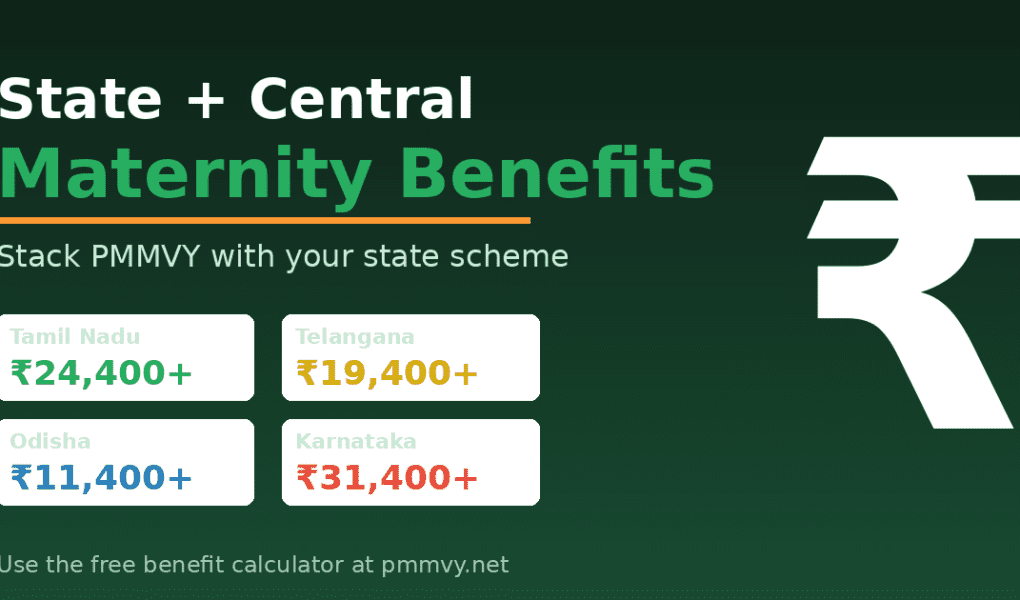
For women in the unorganised sector having their first child in rural areas, the following combination is possible: PMMVY (₹5,000) + JSY (₹1,400) + state scheme (varies). Therefore, total combined benefits can reach ₹24,400 or more in states like Tamil Nadu. Consequently, every eligible woman should actively apply for all applicable schemes and not just one.
How to Apply for PMMVY — Your First Step
Start with PMMVY, as it is the highest-value central scheme for unorganised sector women. Use the PMMVY eligibility checker to confirm your qualification. Then follow the PMMVY online apply guide for step-by-step registration. Additionally, contact your ASHA worker simultaneously to register for JSY. For state schemes, contact your district Women and Child Development office or visit the state government’s welfare portal.
Frequently Asked Questions — Maternity Schemes India 2026
What are the best maternity schemes in India in 2026?
The major schemes are PMMVY (₹5,000), JSY (₹1,400), Maternity Benefit Act (26 weeks paid leave for formal employees), ESI maternity benefit, and various state schemes. Most can be claimed together by eligible women.
Can I claim PMMVY and state maternity scheme together?
Yes. Most state maternity schemes are designed to complement central schemes like PMMVY, not replace them. Apply for both separately through the respective state and central channels.
Which state has the highest maternity benefit in India?
Tamil Nadu’s Dr. Muthulakshmi Reddy scheme provides ₹18,000 — among the highest state-level maternity benefits. Combined with PMMVY and JSY, total support in Tamil Nadu can exceed ₹20,000.
Is there a maternity scheme for government employees?
Yes. Central and state government employees receive paid maternity leave under service rules. However, they are excluded from PMMVY specifically because they already receive government maternity support.
How much total maternity benefit can I receive in India?
In high-coverage states, a rural unorganised sector woman having her first child can receive ₹5,000 (PMMVY) + ₹1,400 (JSY) + state scheme benefits — potentially ₹20,000 or more in total depending on the state.